Buying Guide
How to Read a Ghee Label: 10 Things to Check Before You Buy
Start with the mandatory items: a 14-digit FSSAI licence number, the net quantity (by weight, or by volume with the weight also stated), the maker’s name and address, the date of manufacture and best-before, and an ingredient line that says only milk fat or ghee. Then judge the optional claims — A2, bilona, buffalo or cow, AGMARK, “lab tested” — by whether the brand can show proof for each.
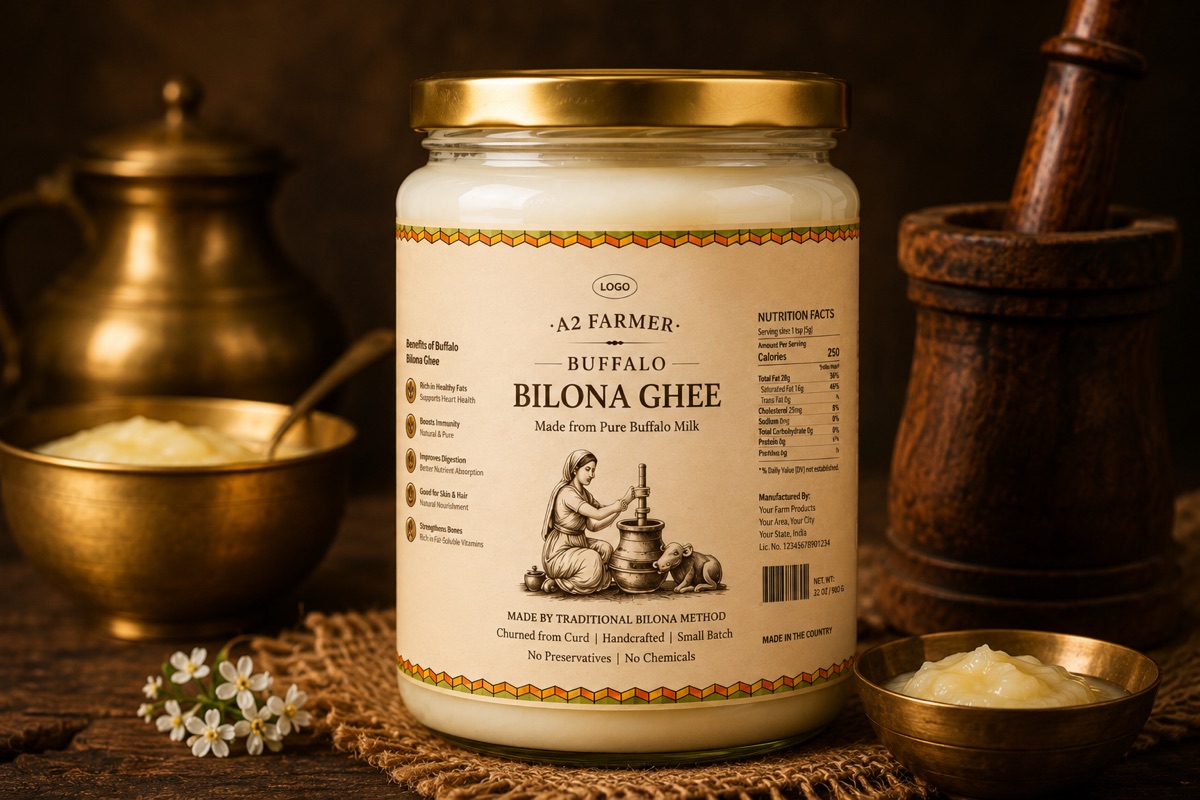
Quick take
- Mandatory: FSSAI licence, net quantity, maker’s address, dates, veg mark, nutrition panel.
- Volume packs (500 ml, 1 L) must also state weight; 1 L of ghee is roughly 0.9 kg.
- Voluntary but useful: AGMARK grade, lab report.
- Claims to verify: A2 (PCR test), bilona (curd route), buffalo or cow (single source).
The mandatory lines
- FSSAI licence number. A 14-digit number with the FSSAI logo. You can look it up on FSSAI’s FoSCoS portal. If it is missing, don’t buy.
- Name of the food. It should say “ghee”. “Vanaspati”, “dairy spread” or “ghee flavoured” are different products (ghee vs vanaspati).
- Ingredients. Ghee should list only milk fat, butter, cream or curd. Added flavour, colour or vegetable fat is a warning sign.
- Net quantity. Ghee may be sold by weight or by volume. Legal Metrology rules require packs declared by volume to state the weight too, because fat expands when warm. 1 litre of ghee weighs about 900–910 g (is ghee sold in litres or kg?).
- Dates. Date of manufacture or packing, and best before or use by. NIFTEM training material puts ghee shelf life at 6–12 months in proper packaging.
- Maker’s name and address, MRP, customer-care contact. A real address lets you hold someone accountable.
- Green vegetarian mark and nutrition panel. Expect about 99–100 g fat and 880–900 kcal per 100 g (ghee nutrition facts).
Voluntary marks worth having
- AGMARK. A voluntary government grading mark under the Ghee Grading and Marking Rules, 2024. Graded ghee is tested against set standards (what AGMARK on ghee means).
- A real lab report. “Lab tested” means little without numbers. Ask for milk fat (at least 99.5%), moisture (at most 0.5%) and a negative Baudouin test, from a NABL-accredited lab (how to read a ghee lab report).
Overview of all the marks: ghee certifications explained.
Claims that need proof
- A2, bilona, buffalo, cow, desi, grass-fed, organic. None of these is certified by FSSAI except organic, which needs the Jaivik Bharat logo. Judge each by evidence:
- A2: ask for a PCR genotype report showing A2A2. FSSAI briefly tried to remove A2 claims in 2024 (the FSSAI A1/A2 advisory), so there is no official A2 standard.
- Bilona: the ghee should start from curd churned into butter, not from cream (bilona vs normal ghee).
- Buffalo or cow: buffalo ghee is naturally whiter; cow ghee is yellower (buffalo ghee vs cow ghee). A single-source claim is easier to trust when the brand names the breed.
- Desi, Vedic, pure: marketing words with no legal definition.
Red flags on a ghee label
- No FSSAI number, or a number that doesn’t match the brand on FoSCoS.
- Only “1 L” with no weight on a volume pack.
- “Bilona” or “A2” at a price close to ordinary ghee. Bilona needs 25–30 litres of milk per kg.
- Health promises such as “cures”, “burns fat” or “no cholesterol”. All ghee contains cholesterol; ours tests 224 mg per 100 g.
- “100% pure” with no lab report behind it.
Home checks you can add: how to identify pure ghee.
Our label, checked the same way
We hold ourselves to the same list. A2 Farmer ghee is sold in glass by volume (250 ml, 500 ml, 1 L, 2 L). It is A2 Murrah buffalo ghee made by the curd-and-churn bilona method, with 99.76% milk fat, 0.24% moisture, a negative Baudouin test and A2A2 confirmed by PCR on our lab report.
Sources & references
- FSSAI. Food Safety and Standards (Labelling and Display) Regulations, 2020
- Food Safety Works. Legal Metrology (Packaged Commodities) Amendment Rules, 2023
- Ghee Grading and Marking Rules, 2024 (G.S.R. 408(E), 16 July 2024), Directorate of Marketing & Inspection
- Business Today. FSSAI withdraws advisory on removal of claims of A1, A2 milk from packaging, 27 August 2024
- A2 Farmer reference lab report (Equinox Labs, NABL-accredited)
Frequently asked questions
What should I check on a ghee label?
The 14-digit FSSAI licence number, net quantity (weight, or volume with weight), ingredients, maker’s address, manufacturing and best-before dates, and proof behind any claims like A2 or bilona.
How do I verify an FSSAI licence number on ghee?
Enter the 14-digit number on FSSAI’s FoSCoS portal and check that the name matches the brand or its manufacturer.
Why does a 1 litre ghee jar show weight too?
Legal Metrology rules require packs declared by volume to also declare weight, because fat expands with temperature. 1 litre of ghee is about 900–910 g.
Is AGMARK mandatory for ghee?
No. AGMARK is a voluntary grading mark. FSSAI licensing is mandatory.
Is an A2 claim on ghee certified?
No. There is no official A2 certification in India. Ask the brand for a PCR genotype report.
A2 ghee, made the bilona way
A2 Farmer Buffalo Bilona Ghee — A2A2 confirmed by PCR, 99.76% milk fat, hand-churned from cultured curd and glass-packed. From ₹799.
Shop A2 Ghee →