A2 Ghee · Regulation
FSSAI’s A1/A2 Advisory Explained: Can Ghee Still Be Labelled A2?
On 21 August 2024 FSSAI advised food businesses to remove “A1” and “A2” claims from milk and milk products, including ghee, saying the claims did not conform to the Food Safety and Standards Act, 2006. On 26 August 2024 it withdrew the advisory for further consultation with stakeholders. Brands can still use A2 claims. We have not found a newer FSSAI rule on A2 as of November 2026, so the question is unsettled. The practical answer for buyers: ask for a genotype test, not just a label.
Quick take
- 21 Aug 2024: FSSAI advisory asks brands to drop A1/A2 claims.
- 26 Aug 2024: withdrawn “for further consultation and engagement with stakeholders”.
- A2 claims are still allowed today; no standard defines or certifies them.
- Buyer takeaway: an A2 claim is only as good as the brand’s PCR test.
What the advisory said
According to news reports of the advisory dated 21 August 2024, FSSAI:
- asked food business operators to remove A1 and A2 claims from milk and milk-product labels, including ghee;
- asked e-commerce platforms to remove such claims from listings immediately;
- gave brands six months to use up pre-printed labels, with no extension;
- reasoned that the A1/A2 difference relates to the structure of beta-casein protein, that its food standards regulations do not recognise this distinction, and that the claims were misleading under the FSS Act, 2006.
Why it was withdrawn
Five days later, on 26 August 2024, FSSAI withdrew the advisory, saying it needed “further consultation and engagement with the stakeholders”. Reports at the time said dairy businesses could continue to sell and market products with A1 and A2 claims. We have not found a later FSSAI notification, consultation outcome or standard on A2 milk or ghee as of November 2026. If you need the current position for a business decision, check fssai.gov.in directly.
Was FSSAI right about the science?
Partly. FSSAI was right that A1 and A2 differ in one amino acid of beta-casein, a milk protein. It was also right that ghee holds very little protein: our own jar tests below 0.01 g protein per 100 g. So an “A2” claim on ghee mostly tells you which animals the milk came from, not how much A2 protein is in the jar (A2 ghee myths).
The health case for A2 milk is still open. EFSA’s 2009 review did not establish a cause-and-effect link between A1-derived peptides and disease, while some later human trials report less digestive discomfort with A2 milk (A1 vs A2 milk research). That uncertainty is exactly why regulators hesitate to endorse or ban the claim.
What it means if you are buying A2 ghee
With no official A2 standard or certification, an “A2” label is the brand’s own claim. That makes evidence more important:
- Ask for a genotype test. PCR testing of the herd’s milk should report A2A2 (A2A2 meaning and testing).
- Prefer simple sources. Indian river buffalo are A2 by nature; in a 2023 study all 172 Murrah buffaloes tested were A2A2 (is buffalo milk A2?). Desi cow herds can carry some A1.
- Check the mandatory things. An FSSAI licence number, net weight, dates and a purity report matter more than any A2 sticker (how to read a ghee label).
- Treat health promises with care. “A2 ghee cures” anything is not a claim the evidence supports.
More: ghee certifications explained and how fake A2 ghee is caught.
Where A2 Farmer stands
We call our ghee A2 ghee because it is made only from Murrah buffalo milk, and the herd’s milk was confirmed A2A2 by TaqMan PCR at a NABL-accredited lab. We do not claim that A2 ghee treats any condition. If FSSAI issues a final rule on A2 labelling, we will follow it and update this page.
Sources & references
- Business Today. FSSAI withdraws advisory on removal of claims of A1, A2 milk from packaging, 27 August 2024
- Food Safety Works. FSSAI: withdrawn order on selling and marketing of milk products such as ghee in the name of A1/A2
- Down To Earth. FSSAI announces curbs on dairy products being labelled as A2, August 2024
- EFSA. Review of the potential health impact of β-casomorphins and related peptides. EFSA Scientific Report 231, 2009
- Kathiravan P et al. β-casein gene polymorphism in crossbred cattle and Murrah / graded Murrah buffalo in Tamil Nadu. Indian Journal of Animal Research, 2023
- A2 Farmer reference lab report (Equinox Labs, NABL-accredited)
Frequently asked questions
Did FSSAI ban A2 ghee?
No. FSSAI advised removing A1/A2 claims on 21 August 2024 but withdrew that advisory on 26 August 2024 for further consultation. A2 ghee can still be sold and labelled.
Is A2 labelling legal in India?
A2 claims are currently used and were not banned after the 2024 advisory was withdrawn. There is no official A2 standard or certification, so check the brand’s own test.
Why did FSSAI object to A2 claims?
It said the A1/A2 difference relates to beta-casein structure, which its food standards do not recognise, and that such claims could mislead consumers.
Is there an official A2 certification in India?
No. A2 status is shown by a genotype (PCR) test of the animals or their milk, done by an accredited lab.
Does ghee contain A2 protein?
Only traces. Ghee is about 99.5% fat; ours tests below 0.01 g protein per 100 g. The A2 label tells you which animals the milk came from.
A2 ghee, made the bilona way
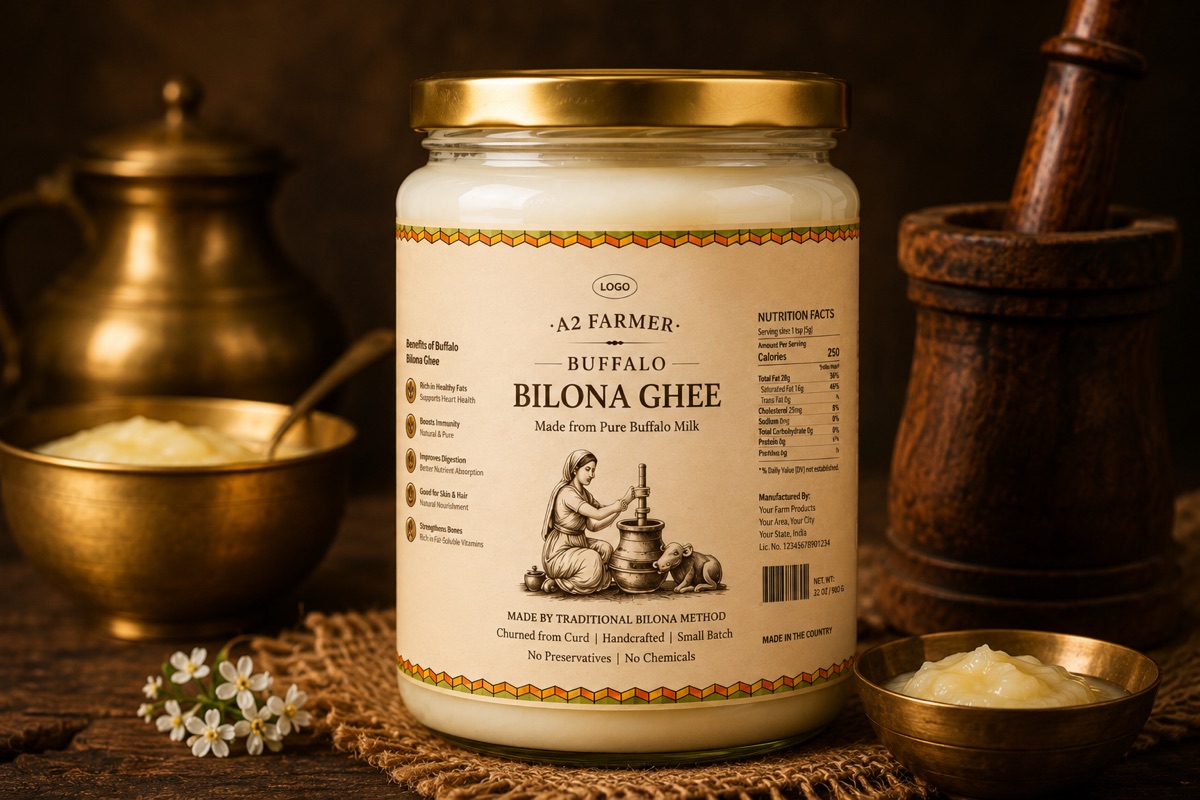
A2 Farmer Buffalo Bilona Ghee — A2A2 confirmed by PCR, 99.76% milk fat, hand-churned from cultured curd and glass-packed. From ₹799.
Shop A2 Ghee →