Bilona Ghee · Compare
Bilona Ghee vs Normal Ghee: What Actually Differs
The difference is the starting material. Bilona ghee starts with whole milk set into curd, which is churned into butter (makhan) and then heated. Normal ghee in shops is usually made in dairies from separated cream or creamery butter. Factory methods recover more fat — about 88–95% against 80–85% for the curd route — which is why they are cheaper. Bilona ghee tastes more aromatic; the nutrition is broadly the same.
Quick take
- Bilona: milk → curd → churned butter → ghee.
- Normal ghee: milk → cream separator → cream or butter → ghee.
- Fat recovery: 80–85% (desi/curd) vs 88–95% (factory).
- Bilona wins on aroma; the fat profile is broadly similar; purity depends on the maker, not the method.
Side by side
| Bilona ghee | Normal (factory) ghee | |
|---|---|---|
| Starting material | Whole milk set into curd | Separated cream or creamery butter |
| Fermentation | Yes, overnight curd | Usually none (sweet cream) |
| Churning | Curd churned in a bilona | Cream churned in a butter churn, or skipped |
| Fat recovery | About 80–85% | 88–92% (creamery butter), 90–95% (direct cream) |
| By-product | Buttermilk (chaas) | Skimmed milk, buttermilk |
| Scale | Small batches | Tonnes per day |
| Typical price | Higher | Lower |
Fat-recovery ranges are from NIFTEM’s ghee-processing training material, a Government of India food-technology institute.
How normal ghee is made
Indian dairy textbooks describe three commercial routes. In the creamery butter method, milk is separated, the cream is pasteurised (about 90°C), churned into butter, melted and boiled to about 107–109°C until the moisture is gone. In the direct cream method, cream goes straight into the ghee kettle with no butter step. Pre-stratification lets melted butter settle so the watery layer, about 74% of the water in the butter, can be drained before boiling, which saves fuel.
These methods are efficient and hygienic, and they make perfectly legal ghee. FSSAI’s definition of ghee allows it to be made from milk, curd, desi butter or cream.
How bilona ghee is made
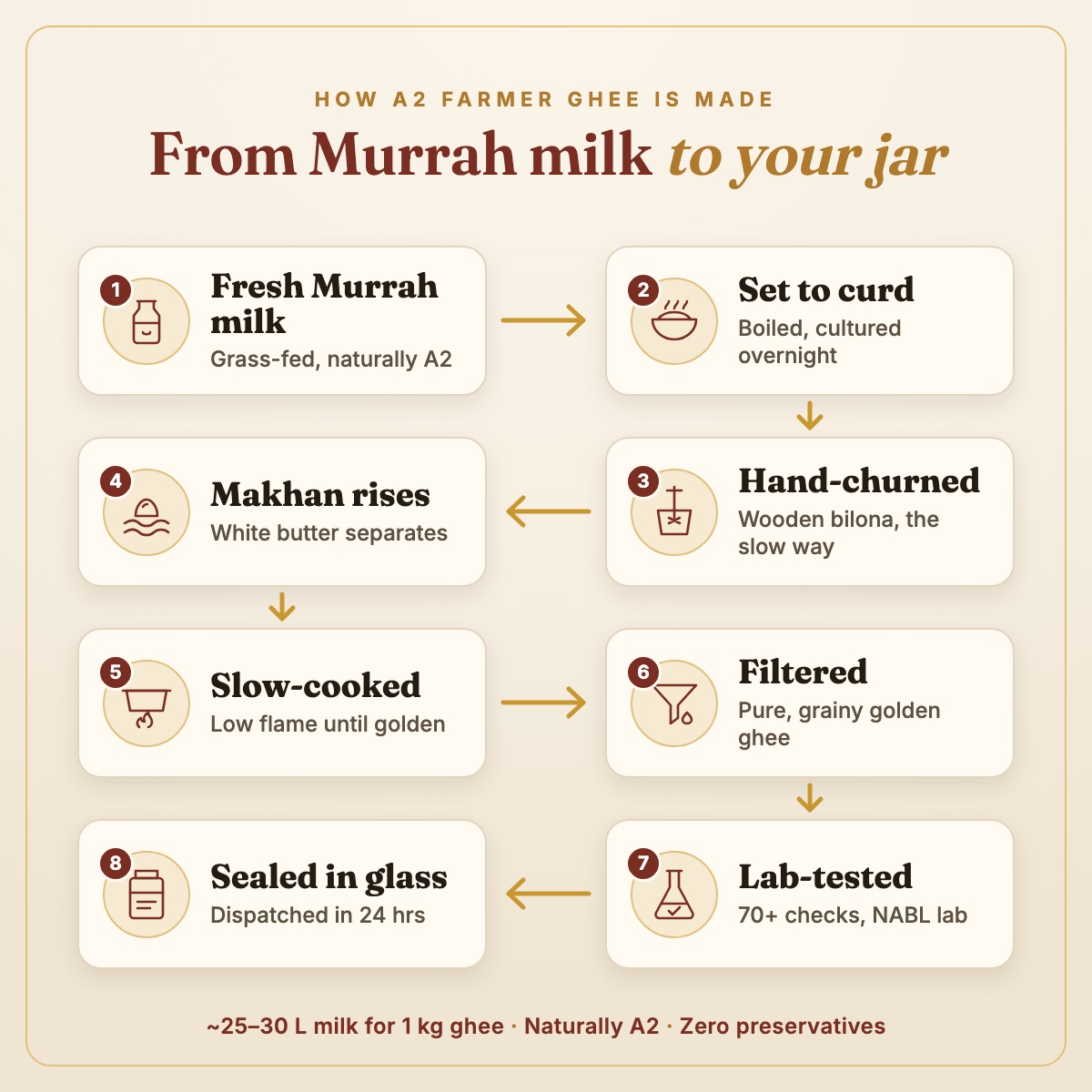
Whole milk is boiled, cooled and set into curd with a little of yesterday’s curd as starter. The curd is churned in a wooden bilona until butter floats, and the butter is slowly heated until the solids brown and the ghee separates. The step-by-step version, with photos: the bilona method explained.
Because the milk is not separated, the curd route loses more fat into the buttermilk. That is the main reason bilona needs 25–30 litres of milk per kg of ghee.
Taste and aroma
This is where the methods really differ. The e-PG Pathshala dairy-technology module notes that desi ghee from makhan gets its distinctive flavour from aromatic compounds formed while the dahi ferments, and that ghee from cultured cream scores higher for flavour than ghee from uncultured cream. Bilona ghee therefore tastes nuttier and slightly tangy; sweet-cream ghee tastes milder. Texture also differs: slow cooling helps bilona ghee set into grains (danedar ghee).
Is bilona ghee healthier than normal ghee?
Not in any way that has been measured well. Both are about 99.5% milk fat with similar calories (about 45 kcal per teaspoon). Fermentation lowers lactose in the curd, but ghee carries almost no lactose or protein whichever way it is made. Claims that bilona ghee has “more vitamins” or “more omega-3” than normal ghee are not supported by published comparisons (omega-3 in ghee). What the method does change, besides flavour, is traceability: a small curd-based maker usually works from a known herd.
Purity is a separate question. A badly made bilona ghee can be adulterated; a factory ghee can be very pure. Check milk fat (at least 99.5%), moisture (at most 0.5%) and a negative Baudouin test, whatever the label says.
Which should you buy?
- For everyday cooking on a budget: a reputable normal ghee with an FSSAI licence and, ideally, AGMARK.
- For flavour, tradition and a known source: genuine bilona ghee — see how to choose the best bilona ghee in India.
- For A2 as well: bilona ghee from A2 milk, such as pure buffalo milk (A2 ghee vs bilona ghee).
Comparing with home-made malai ghee instead? See malai ghee vs bilona ghee.
Sources & references
Frequently asked questions
What is the difference between bilona ghee and normal ghee?
Bilona ghee is made from whole-milk curd churned into butter; normal shop ghee is usually made from separated cream or creamery butter in a dairy.
Why is bilona ghee more expensive than normal ghee?
The curd route recovers less fat (about 80–85% against 88–95% for factory methods), works in small batches and needs 25–30 litres of milk per kg.
Is bilona ghee healthier than normal ghee?
The fat profile and calories are broadly the same. Bilona ghee tastes more aromatic; no published study shows a large nutritional difference.
Does bilona ghee taste different?
Yes. Fermenting the curd forms aroma compounds, so bilona ghee tastes nuttier and slightly tangy, and often sets into grains.
Is normal ghee pure?
It can be. Purity depends on the maker. Look for milk fat of at least 99.5%, moisture of at most 0.5% and a negative Baudouin test.
A2 ghee, made the bilona way
A2 Farmer Buffalo Bilona Ghee — A2A2 confirmed by PCR, 99.76% milk fat, hand-churned from cultured curd and glass-packed. From ₹799.
Shop A2 Ghee →