A2 Ghee · Proof
How to Read an A2 Ghee Lab Report: Every Test Explained
A trustworthy A2 ghee lab report comes from a NABL-accredited lab and shows four things: milk fat of at least 99.5%, moisture of 0.5% or less, a negative Baudouin test (no vanaspati), and an A2A2 genotype result from a DNA test such as TaqMan PCR on the herd’s milk. Our own report shows 99.76% milk fat, 0.24% moisture, Baudouin negative and A2A2 confirmed.
Quick take
- Purity tests (milk fat, moisture, Baudouin) prove it is real ghee.
- The A2 test is a DNA genotype test on the milk — ghee itself has almost no protein to test.
- Check the lab: NABL accreditation, report date and the product name should all be on the page.
- A report that shows only “fat %” proves the ghee is ghee, not that it is A2.
“Lab-tested” is printed on almost every premium ghee jar now. A report is only useful if you can read it, so this guide walks through each line you are likely to see, what a good result looks like, and which tests are missing from weak reports. We use our own reference report as the worked example.
Prefer proof over promises? Order lab-tested A2 ghee with cash on delivery.
First, check who did the testing
- NABL accreditation. In India, the National Accreditation Board for Testing and Calibration Laboratories accredits labs for specific tests. Look for the NABL mark and certificate number on the report.
- Product and batch. The report should name the product (for example “Buffalo Bilona Ghee”), the brand and a sample or batch reference.
- Date. A report from years ago says little about today’s jar. Ask how often the brand tests.
Our report was issued by Equinox Labs, a NABL-accredited laboratory, and covers 70+ parameters.
The purity tests, line by line
| Test | What it shows | Legal standard | Our result |
|---|---|---|---|
| Milk fat | How much of the jar is butterfat | ≥ 99.5% | 99.76% |
| Moisture | Water left after cooking; high moisture spoils faster | ≤ 0.5% | 0.24% |
| Baudouin test | Presence of vanaspati / sesame oil | Negative | Negative |
| Trans fat | Hydrogenated (industrial) fat | — | < 0.1 g / 100 g |
Standards per FSSAI’s food product standards for ghee. Results from our reference report.
Two more values often appear on ghee reports: the Reichert-Meissl (RM) value, which measures volatile short-chain fatty acids typical of milk fat, and the Butyro-refractometer (BR) reading, which shifts when foreign oils are mixed in. FSSAI sets ranges for both that vary by region. A result inside the range for the product’s state is what you want; a result far outside it is a red flag for blending.
The A2 test: a DNA test, not a protein test
“A2” describes the beta-casein protein in milk. Ghee is almost pure fat; our report shows protein below 0.01 g per 100 g. So you cannot meaningfully test a spoon of ghee for A1 or A2 protein.
What a credible brand tests instead is the genotype of the milk: a DNA method such as TaqMan PCR reads the beta-casein gene from cells in the milk and reports A1A1, A1A2 or A2A2. A2A2 means only the A2 gene is present. Our Murrah buffalo milk tested A2A2. More on the result codes: what A2A2 means.
- Good sign: the report names the method (PCR, sequencing) and the sample (milk from the herd).
- Weak sign: “A2 certified” with no method, no lab and no date.
Nutrition panel: what the numbers mean
The nutrition section tells you what you are eating rather than whether it is pure. Our per-100 g values: 898 kcal, saturated fat 71.4 g, monounsaturated (MUFA) 26.5 g, polyunsaturated (PUFA) 1.9 g, cholesterol 224 mg. Per teaspoon (about 5 g) that is roughly 45 kcal. The fat breakdown is explained in A2 ghee fatty acids.
Red flags on a ghee report
- No lab name, no accreditation, or a lab that does not list ghee testing in its scope.
- Only one line (“fat 99.8%”) and nothing on Baudouin, moisture or genotype.
- A report for a different product, or a blurred image you are not allowed to see in full.
- An “A2” claim with no genotype test at all (how to spot fake A2 ghee).
You can ask us for our full report on WhatsApp or by email; the summary is on the lab report page. For checks you can do at home, see how to identify pure ghee, and for the bigger picture, what A2 ghee is.
Sources & references
Frequently asked questions
What should an A2 ghee lab report show?
It should come from a NABL-accredited lab and show milk fat of at least 99.5%, moisture of 0.5% or less, a negative Baudouin test, and an A2A2 genotype result from a DNA test such as PCR on the herd's milk.
Can you test ghee for A2 protein?
Not meaningfully. Ghee is almost pure fat and contains under 0.01 g protein per 100 g, so A2 status is confirmed by genotype-testing the milk with a DNA method like TaqMan PCR.
What does a negative Baudouin test mean?
It means no vanaspati or sesame oil was detected. The Baudouin test is the standard legal check for the most common ghee adulteration.
What is a good moisture level for ghee?
FSSAI allows up to 0.5% moisture. Lower is better for shelf life; A2 Farmer ghee tested at 0.24%.
Is NABL accreditation important?
Yes. NABL accreditation means the lab's methods for that test have been independently assessed, so the result carries more weight than an in-house or unaccredited test.
A2 ghee with the report to back it
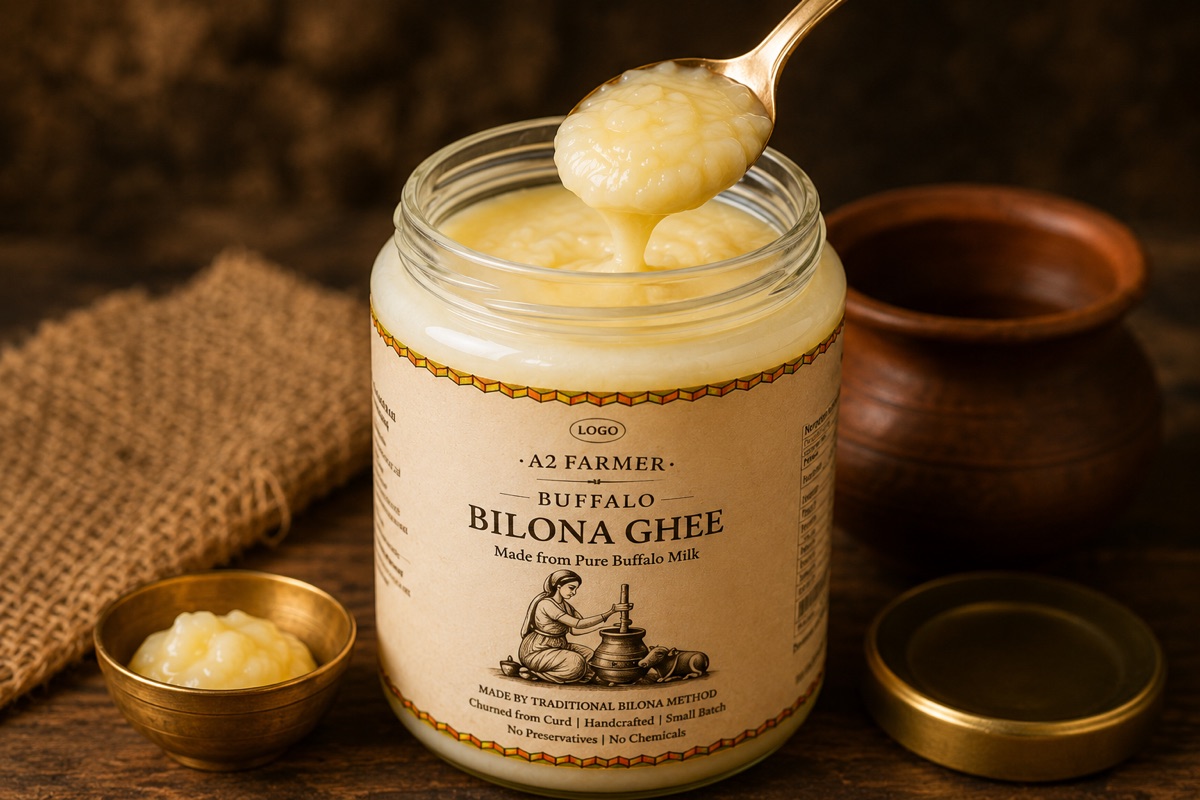
A2 Farmer Buffalo Bilona Ghee — A2A2 confirmed by PCR, 99.76% milk fat, hand-churned and glass-packed. From ₹799.
Shop A2 Ghee →