Pure Ghee
How to Check if Your Ghee Is Pure: 6 At-Home Tests
Melt a little in a hot pan — pure ghee melts fast to a clear golden liquid with a nutty aroma, and melts on your palm. Grainy texture in winter is normal.
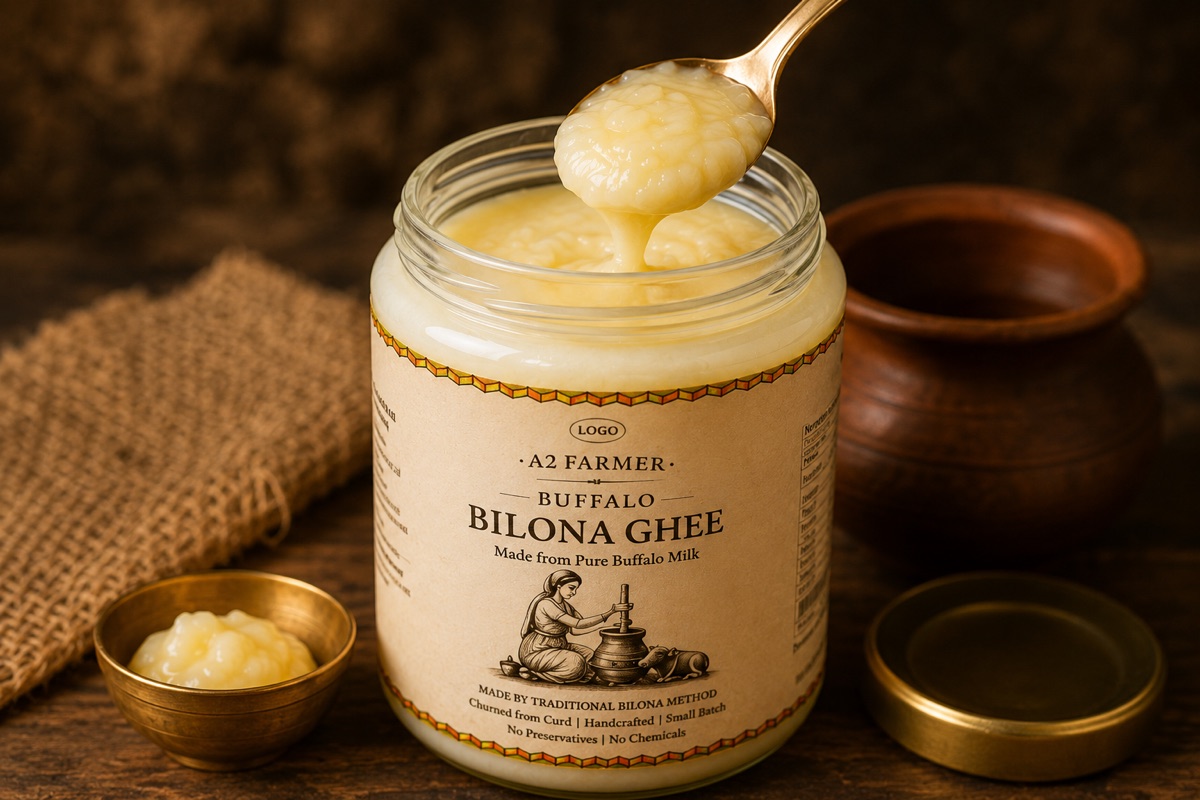
Quick checks
- Pure ghee melts fast to a clear golden liquid, smells nutty, and melts on your palm.
- It naturally turns grainy/solid in winter and liquid in summer — that's purity, not a fault.
- The only definitive proof is a lab report — milk fat %, Baudouin test, RM value.
Ghee is one of the most commonly adulterated foods in India — cut with vanaspati (hydrogenated oil), refined oils, mashed potato, even animal fat. The good news: you can catch most fakes with a few simple kitchen tests. Here are six, from easiest to most telling — plus what a real lab actually measures.
1. The heat / melt test
Heat a teaspoon of ghee in a hot pan. Pure ghee melts almost immediately into a clear, golden liquid and gives off a nutty aroma. Adulterated ghee tends to melt slowly, stays pale or whitish, and may smell flat or oily.
2. The palm test
Place a little ghee on your palm. Pure ghee melts from body heat alone within moments. If it just sits there and needs real warmth to soften, be suspicious.
3. The double-boiler (heat & cool) test
Melt ghee gently, then let it cool at room temperature. Pure ghee will set evenly. If the fat separates into layers — one settling at the bottom — it's likely mixed with another oil or fat.
4. The refrigeration / grain test
Pure ghee behaves predictably with temperature: grainy and solid in winter, clear liquid in summer. This natural change is one of the simplest signs of authenticity. Ghee that stays exactly the same texture year-round has often been altered.
5. The hydrochloric acid test (for vanaspati)
In a clear glass, add a teaspoon of melted ghee, an equal amount of hydrochloric acid, and a pinch of sugar. Shake and let it sit. If a red or crimson colour develops at the bottom, it indicates vanaspati (hydrogenated fat) adulteration. (Handle acid carefully, keep away from children, and only if you're comfortable doing so.)
6. The iodine test (for starch)
Add a couple of drops of tincture of iodine to a little melted ghee. If it turns blue or purple, starch (like mashed potato or sweet potato) has been added as a filler. Pure ghee won't change colour.
What a real lab report actually checks
Home tests are useful, but they can't be conclusive. That's what accredited food labs are for. When we send our ghee to a NABL-accredited lab, these are the purity markers that matter:
- Milk fat % — should be at least 99.5% for pure ghee.
- Baudouin test — detects vanaspati / foreign fats; must be negative.
- Reichert-Meissl (RM) value — a fingerprint of genuine dairy fat.
- Butyro-refractometer (BR) reading & Moisture — flag dilution and adulteration.
The simplest rule of all
Do the kitchen tests for peace of mind — but for real certainty, buy from a maker who will show you a lab report and tell you exactly how the ghee is made. Genuine bilona ghee from a named source, packed in glass, with test results to back it, is the safest bet.
Sources & references
Frequently asked questions
How can I check if ghee is pure at home?
Melt a little in a hot pan — pure ghee melts fast to a clear golden liquid with a nutty aroma, and melts on your palm. Grainy texture in winter is normal.
Does pure ghee become grainy?
Yes — pure ghee turns grainy and solid in winter and liquid in summer. That's a sign of purity.
What lab tests confirm ghee purity?
Milk fat %, the Baudouin test for vanaspati, RM value, BR reading and moisture. Ours tested at 99.76% milk fat with a negative Baudouin test.
Purity you can actually verify
A2 Farmer Buffalo Bilona Ghee — lab-tested, glass-packed, nothing to hide.
Shop Pure Ghee →