Buffalo Ghee · Purity
Pure Buffalo Ghee: How to Check It at Home and on a Lab Report
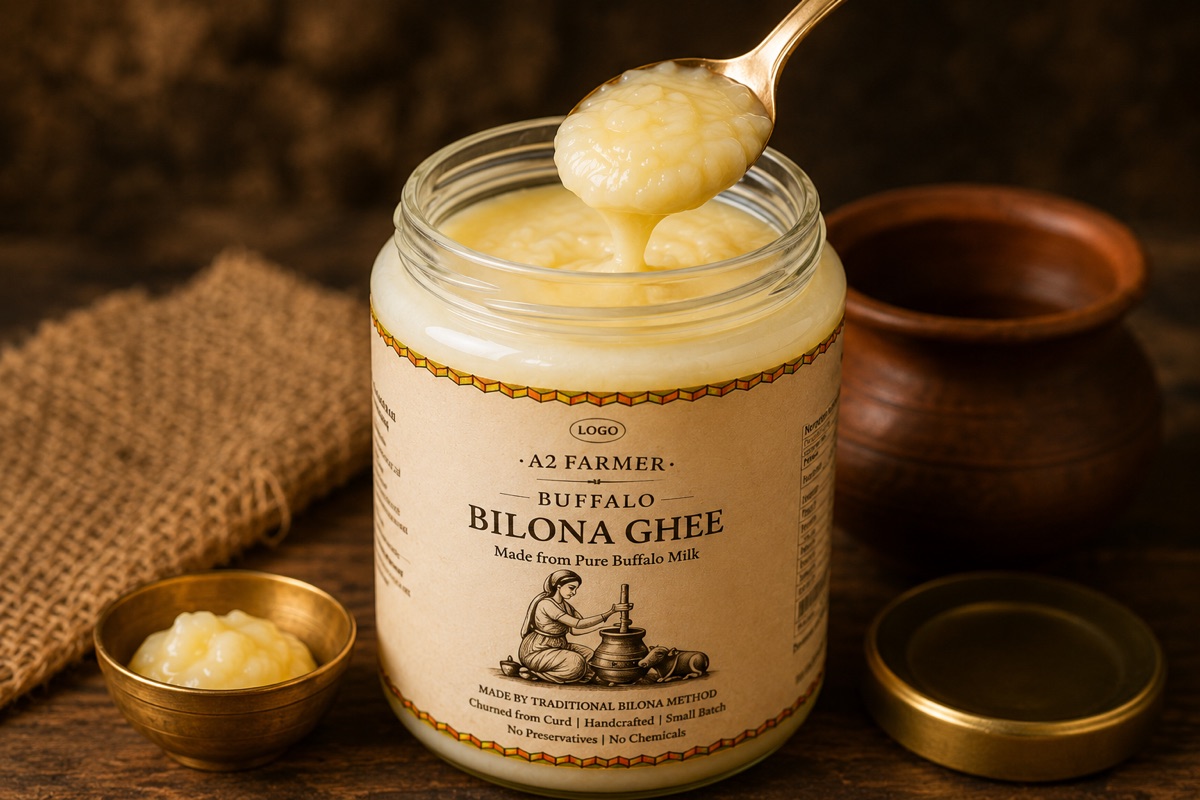
Pure buffalo ghee is white to off-white, sets grainy and firm in cool weather, melts slowly in the hand and smells nutty, never waxy. Home checks only screen out obvious fakes. The proof is a lab report showing milk fat of at least 99.5%, moisture of at most 0.5%, a negative Baudouin test (no vanaspati) and buffalo-typical constants such as a Reichert-Meissl value near 32.
Quick take
- Colour: white/off-white. A strong yellow tint suggests cow fat or added colour.
- Texture: grainy, firm when cool; melts at a higher range than cow ghee.
- Lab: fat ≥99.5%, moisture ≤0.5%, Baudouin negative.
- Price: pure buffalo ghee can’t sell far below the cost of milk.
What pure buffalo ghee looks and feels like
- Colour: white or creamy off-white. Buffalo convert the yellow pigment beta-carotene into colourless vitamin A, so their ghee has very little yellow. Indian data give buffalo ghee about 0.8 yellow units on the tintometer against 8.8 for cow ghee (why buffalo ghee is white).
- Texture: sets firm and grainy (danedar) when cool. Buffalo ghee melts over about 32–43.5°C, against 28–41°C for cow ghee, so it stays solid longer.
- Aroma: rich, nutty and milky. A waxy, flat or “oily” smell is a warning sign.
- Taste: clean, slightly sweet, no bitterness or sharp aftertaste.
Home checks, and their limits
- Colour against a white plate. Strongly yellow “buffalo ghee” is likely cow fat or coloured.
- Palm melt. A small spoonful should soften slowly and smell nutty; vanaspati often feels greasy and smells flat.
- Fridge set. Pure ghee sets evenly. Separate oily layers can mean added oil.
- Pan heat. Pure ghee melts clear and golden-brown quickly with a nutty aroma; a lot of foam or a burnt-oil smell is suspect.
Be realistic: a skilled blend of ghee with a little vanaspati or refined oil can pass every kitchen test. Home checks catch crude fakes; only a lab catches careful ones. More home methods: how to identify pure ghee and, in Hindi, भैंस के घी की पहचान.
The lab numbers that settle it
| Test | Pure buffalo ghee | What it catches |
|---|---|---|
| Milk fat | ≥99.5% (FSSAI) | Water, solids, fillers |
| Moisture | ≤0.5% (FSSAI) | Poor cooking; spoils early |
| Baudouin test | Negative | Vanaspati or sesame oil |
| Reichert-Meissl (RM) value | ~32 (cow ghee ~27) | Low values point to foreign fat |
| Iodine value | ~29 (cow ghee ~34) | High values point to vegetable oils |
RM and iodine values are typical figures from Indian dairy-technology data quoted by NIFTEM; FSSAI sets its own limits, which vary by state. Milk fat comes only from milk, so the RM value, which measures the short-chain fatty acids typical of milk fat, drops when vegetable fat is mixed in. How to read a full report: ghee lab report explained.
The cow-ghee mix problem
A common shortcut is not vanaspati but cheaper mixed or crossbred cow milk fat sold as “buffalo ghee”. It is still real ghee, but it is not what the label says, and it is no longer reliably A2. Clues: a yellow tint, softer texture, and a price close to ordinary cow ghee. A genotype test on the source milk and a named breed (for example Murrah) are the strongest assurance (A2 buffalo ghee).
A price sanity check
Real buffalo bilona ghee needs many litres of milk per kilo (how much milk for 1 kg ghee). A jar priced well below the milk it would take is very unlikely to be pure. Typical prices and what drives them: buffalo ghee price.
How A2 Farmer proves it
Our Murrah buffalo ghee tests at 99.76% milk fat, 0.24% moisture and a negative Baudouin test at a NABL-accredited lab, with the herd’s milk confirmed A2A2 by PCR (lab report). It is white, grainy and glass-packed. If you are comparing jars, use the same checklist on every brand: how to choose the best buffalo ghee.
Sources & references
- NIFTEM (PMFME scheme). Ghee Processing: composition and analytical constants of buffalo and cow ghee (citing Aneja et al., Technology of Indian Milk Products)
- FSSAI. Food Safety and Standards Regulations (food product standards, including ghee)
- A2 Farmer reference lab report (Equinox Labs, NABL-accredited)
Frequently asked questions
How can I check if buffalo ghee is pure?
At home, look for white colour, a grainy firm texture and a nutty smell. For proof, ask for a lab report: milk fat at least 99.5%, moisture at most 0.5% and a negative Baudouin test.
What colour is pure buffalo ghee?
White to creamy off-white. Buffalo turn beta-carotene into colourless vitamin A, so their ghee has little yellow.
Can home tests detect adulterated ghee?
Only crude fakes. A careful blend with a little vanaspati or oil can pass kitchen tests; a lab test is needed to be sure.
What is the Baudouin test for ghee?
A lab test for sesame oil, the standard check for vanaspati and oil adulteration in ghee. Pure ghee should test negative.
Why is pure buffalo ghee grainy?
Slow cooking and slow cooling let the fat crystallise into grains, and buffalo ghee’s higher melting range keeps them firm.
A2 ghee, made the bilona way
A2 Farmer Buffalo Bilona Ghee — A2A2 confirmed by PCR, 99.76% milk fat, hand-churned from cultured curd and glass-packed. From ₹799.
Shop A2 Ghee →