Buffalo Ghee
Why Is Buffalo Ghee White? Colour, Grainy Texture & Melting Point
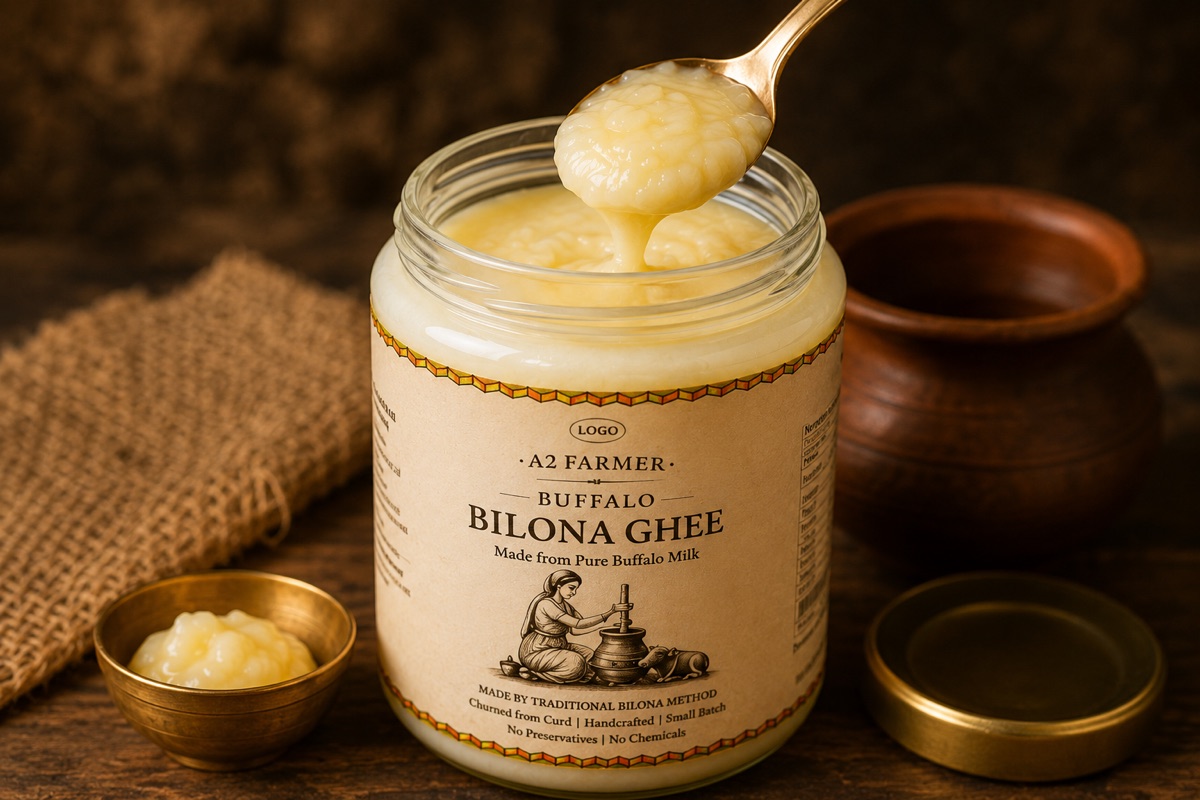
Buffalo ghee is white because buffalo convert almost all the yellow pigment beta-carotene from grass into colourless vitamin A, while cows pass some beta-carotene into their milk fat, making cow ghee yellow. Buffalo ghee is also grainier and stays solid at slightly higher temperatures because its fat has more long-chain saturated fatty acids.
Quick take
- White colour: beta-carotene is converted to vitamin A, so no yellow pigment.
- Grainy (danedar): high-melting fats crystallise as the ghee cools slowly.
- Melting: soft in the high 20s °C, fully liquid around 40–45°C.
- Colour alone does not prove purity — a lab report does.
Buffalo ghee colour: the beta-carotene science
Grass is full of beta-carotene, the orange-yellow pigment in carrots. Cows absorb some of it straight into their milk fat, which is why cow ghee is golden-yellow and why grass-fed cow ghee is deeper yellow in monsoon. Buffalo are far more efficient at converting beta-carotene into vitamin A, which is colourless. The result is white to creamy-white ghee — with its vitamin A intact, just not visible. When warm and liquid, buffalo ghee looks pale gold; as it sets, it turns white.
Why buffalo ghee is grainy (danedar)
Buffalo milk fat contains more long-chain saturated fatty acids that solidify at higher temperatures. When ghee cools slowly after cooking, these fats crystallise into the small grains Indian households call danedar. Grainy texture is a classic sign of slowly made, pure ghee — but it can be faked, so do not rely on it alone (how to identify pure ghee).
Buffalo ghee melting point
Ghee is a mix of fats, so it has a melting range, not a single point. Pure ghee starts softening in the high 20s °C and is fully liquid by roughly 40–45°C. Buffalo ghee tends to stay solid at slightly higher temperatures than cow ghee. That is why the same jar is solid in a Delhi winter and liquid in a Mumbai summer — normal behaviour, not spoilage.
| Buffalo ghee | Cow ghee | |
|---|---|---|
| Colour (set) | White to creamy-white | Golden-yellow |
| Texture | Thick, distinctly grainy | Softer, finer grain |
| Melting behaviour | Stays solid slightly longer | Softens a little sooner |
| Flavour | Rich, creamy | Aromatic, lighter |
Full comparison: buffalo ghee vs cow ghee. Every type of ghee side by side: types of ghee.
Does colour tell you if ghee is pure?
No. White ghee is not automatically buffalo, and yellow ghee is not automatically cow — colour can be added, and vanaspati is also white. The only reliable proof is a lab report: milk fat ≥ 99.5% and a negative Baudouin test. Ours is public on the A2 Farmer lab report. If you are new to buffalo ghee, start with what is buffalo ghee.
Frequently asked questions
Why is buffalo ghee white?
Buffalo convert the yellow pigment beta-carotene into colourless vitamin A, so very little pigment reaches the milk fat. Cows pass more beta-carotene into their milk, making cow ghee yellow.
What is the melting point of buffalo ghee?
Ghee melts over a range: it softens in the high 20s degrees Celsius and is fully liquid at roughly 40 to 45 degrees Celsius. Buffalo ghee tends to stay solid slightly longer than cow ghee.
Why is my ghee grainy?
Grainy, or danedar, ghee forms when high-melting fats crystallise as ghee cools slowly. It is typical of pure, slowly made ghee, especially buffalo ghee.
Is white ghee pure?
Colour alone cannot tell you. Buffalo ghee is naturally white, but vanaspati is white too. Check for a lab report with milk fat of at least 99.5 percent and a negative Baudouin test.
Naturally white. Naturally A2.
A2 Farmer Buffalo Bilona Ghee — naturally A2, hand-churned, 99.76% milk fat, glass-packed. From ₹649.
Shop Pure Ghee →