Ghee 101 · Storage
Why Does Ghee Turn White or Solid? (And Is It Still Good?)
Ghee turns white and solid when it cools because its high-melting saturated fats crystallise. The tiny crystals scatter light, so clear golden ghee becomes opaque: pale yellow-white for cow ghee and bright white for buffalo ghee. This is normal and reversible — warm the jar and it turns clear again. Ghee has gone bad only if it smells sour, rancid or soapy, tastes bitter, or shows mould.
Quick take
- White = crystallised fat, not spoilage.
- Ghee is soft in the high 20s °C and fully liquid around 40–45 °C.
- Buffalo ghee sets whiter than cow ghee (no beta-carotene).
- Bad ghee smells rancid or sour — colour alone is not a sign.
“My ghee has turned white — is it spoiled?” is one of the questions we get most in winter. Almost always, the answer is no. Here is what is happening in the jar.
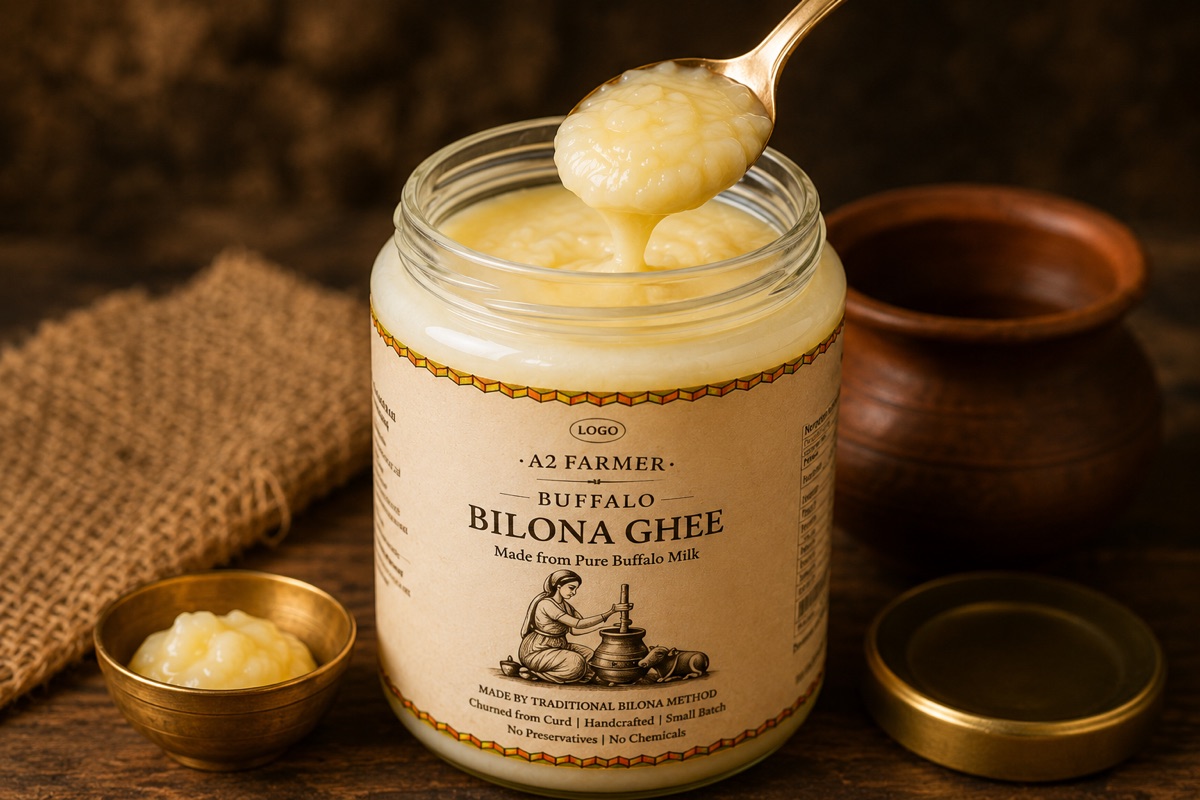
Our A2 buffalo bilona ghee is naturally white and grainy when set, and clear gold when warm.
What happens when ghee cools
Ghee is almost pure milk fat, and milk fat is a mix of many fats with different melting points. In our lab report, saturated fat is 71.4 g per 100 g; much of it is palmitic and stearic acid, which melt well above room temperature. When warm ghee cools, these high-melting fats start to crystallise first. Millions of tiny crystals scatter light, so the ghee goes from transparent to opaque — the same reason clear ice turns white when it is full of tiny bubbles or crystals.
Because it is a mix, ghee has a melting range, not a single point: it softens in the high 20s °C and is fully liquid by about 40–45 °C. That is why the same jar is solid in a Delhi winter and runny in a Mumbai summer.
Cow ghee colour vs buffalo ghee colour
Set cow ghee is pale yellow to creamy-white; set buffalo ghee is bright white. The difference is beta-carotene: cows pass some of this yellow pigment from grass into their milk fat, while buffalo convert almost all of it into colourless vitamin A. Full explanation: why is buffalo ghee white.
Grainy or smooth?
How fast ghee cools decides the texture. Slow cooling at room temperature lets crystals grow into the distinct grains called danedar; quick cooling in a fridge makes many small crystals and a smoother, paste-like ghee. Neither is better for eating (danedar ghee explained).
You may also see layers: a clear liquid top over a white base, or white patches in yellow ghee. That happens when a jar half-melts on a warm day and re-sets. It is the same ghee.
Normal or spoiled? How to tell
| Normal (safe) | Spoiled (discard) |
|---|---|
| White, pale yellow or golden | Sour, rancid, “old paint” or soapy smell |
| Solid, grainy, smooth or layered | Bitter or sharp taste |
| Turns clear when warmed | Mould spots (usually after a wet spoon) |
| Nutty, buttery aroma | Water droplets or a sour liquid layer |
Rancidity comes from oxygen, light, heat and moisture, not from cold. The commonest cause of spoiled ghee at home is a wet or dirty spoon.
Does white ghee mean pure (or fake)?
Neither. Pure cow ghee goes pale when set, pure buffalo ghee is white, and vanaspati is also white. Colour cannot prove purity either way. A lab report can: milk fat of at least 99.5% and a negative Baudouin test for vanaspati (our report, how to identify pure ghee).
Keeping ghee at its best
- Always use a dry, clean spoon.
- Close the lid tightly; store away from the stove and sunlight.
- Room temperature is fine for regular use; the fridge is fine too, it just sets harder.
- To soften, stand the jar in warm water. Avoid melting and re-setting it again and again.
More tips: how to store ghee and buffalo ghee in winter.
Sources & references
Frequently asked questions
Why does ghee turn white?
As ghee cools, its high-melting saturated fats crystallise. The tiny crystals scatter light and make the ghee opaque and white. Warming it makes it clear again.
Is white ghee spoiled?
No. White or solid ghee is normal. Ghee is spoiled only if it smells sour, rancid or soapy, tastes bitter, or shows mould.
Why does ghee become solid?
Ghee is soft in the high 20s degrees Celsius and fully liquid only around 40 to 45 degrees Celsius, so it sets at cooler room temperatures and in the fridge.
What colour is pure cow ghee?
Golden when melted and pale yellow to creamy-white when set. Grass-fed cow ghee is deeper yellow because of beta-carotene.
Why is my ghee grainy?
Slow cooling lets the fat crystals grow into grains, called danedar ghee. Fast cooling in a fridge gives smoother ghee. Both are normal.
White when set, gold when warm
A2 Farmer Buffalo Bilona Ghee — A2A2 confirmed by PCR, 99.76% milk fat, hand-churned and glass-packed. From ₹799.
Shop A2 Ghee →